

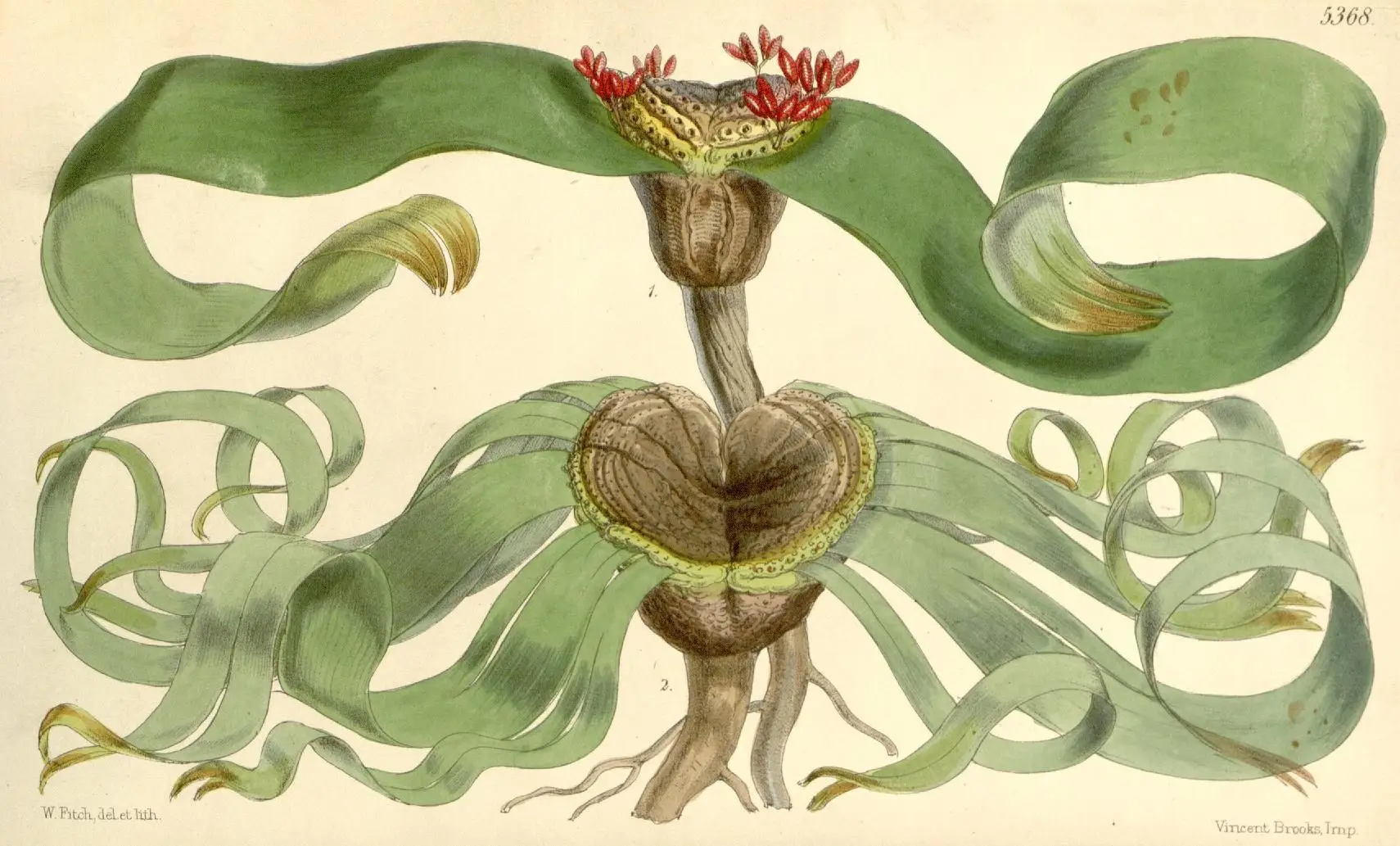
The Welwitschia mirabilis – also known as tree tumbo, tweeblaarkanniedood (‘two leaves; can’t die’) in Afrikaans, nyanka in Damara or onyanga in Herero – may at first glance look rather strange, or even a little forlorn, with just two leaves (with withered ends). But believe it or not, this remarkable species can live for more than 1,000 years. And that is not its only bizarre feature. Step into the world of this desert marvel!
by Sarina VeldmanEternal life
Welwitschia has not been given the epithet mirabilis (meaning wonderful, extraordinary, remarkable) for nothing; it is a unique plant in several respects. It occurs naturally only in the Namib Desert in south-west Africa, where the average annual rainfall is just 20–200 mm. From its largely underground stem grow two (very occasionally more) large, long leaves, which split and curl as the plant ages due to the desert winds.
The plant has a long taproot, but it absorbs water mainly through a horizontally spreading network of fine roots. The leaves also take in some moisture from dew and from the fog banks that regularly hang over the coastal regions of the desert.
Platypus
A large proportion of plant species were described in 1753 by the Swedish botanist Carolus Linnaeus in his book Species Plantarum, but Welwitschia mirabilis was not observed by a European botanist until more than a century later. Dr Friedrich Welwitsch encountered the plant in southern Angola. A letter describing his discovery to the director of the famous Kew Gardens near London was immediately published and attracted great interest among botanists throughout Europe.
Shortly afterwards, sketches and the first plant specimens were sent to Europe, and in 1862 the plant was formally described by Joseph Dalton Hooker. To honour Dr Welwitsch’s significant contribution to botany in tropical Africa, the plant was named after him. Charles Darwin, a close friend of Hooker, wrote to him: “Your African plant seems to be a vegetable Ornithorhynchus” – in other words, “Your African plant resembles a botanical platypus.”
Seeds - but no flowers
Welwitschia mirabilis has no living close relatives. It is the only species within the genus Welwitschia, which in turn is the sole genus in the plant family Welwitschiaceae. By comparison, the pine family (Pinaceae) contains 220–250 species across 11 genera, and the rose family (Rosaceae) includes more than 4,000 species across 91 genera.
Welwitschia belongs to the gymnosperms, a group that also includes conifers and cycads, meaning it produces seeds but no flowers or fruits. The plant is dioecious, with male and female reproductive organs occurring on separate plants. Female plants produce large cone-like structures for seed development, while male plants form smaller cones that release pollen.
Pollination depends largely on insects, which are attracted by sugary pollination droplets and the pollen contained within the cone structures. The silvery-white seeds have thin wings and are dispersed by the wind. Germination only occurs when the region experiences several days of rainfall. Fortunately, the seeds remain viable for several years, allowing them to wait for the right conditions.
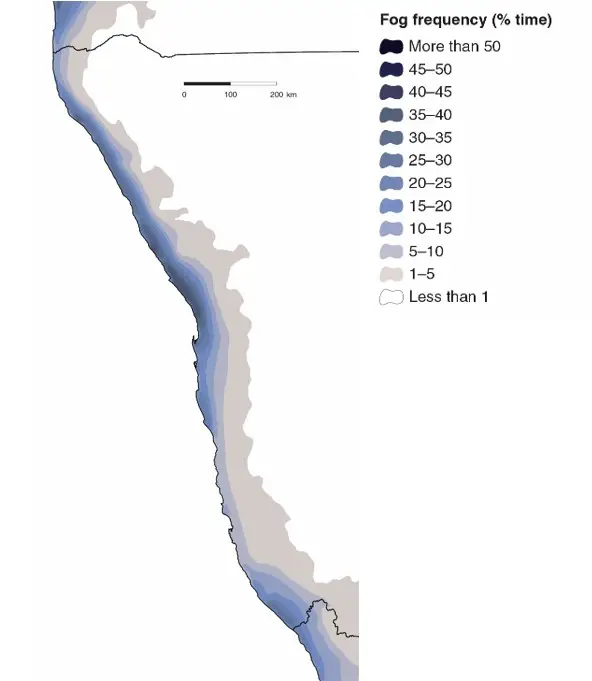
Annual fog average in the Namib Desert
Fog plays a crucial role in much of the Namib Desert’s climate. This sea fog occurs throughout the year in a coastal belt that can extend more than 100 kilometres inland. On this map—compiled using satellite and ground-based data—you can see the average frequency of fog and low cloud cover along the entire Namibian coast. Further inland, fog or low cloud is most common during the spring and summer months, between September and March.
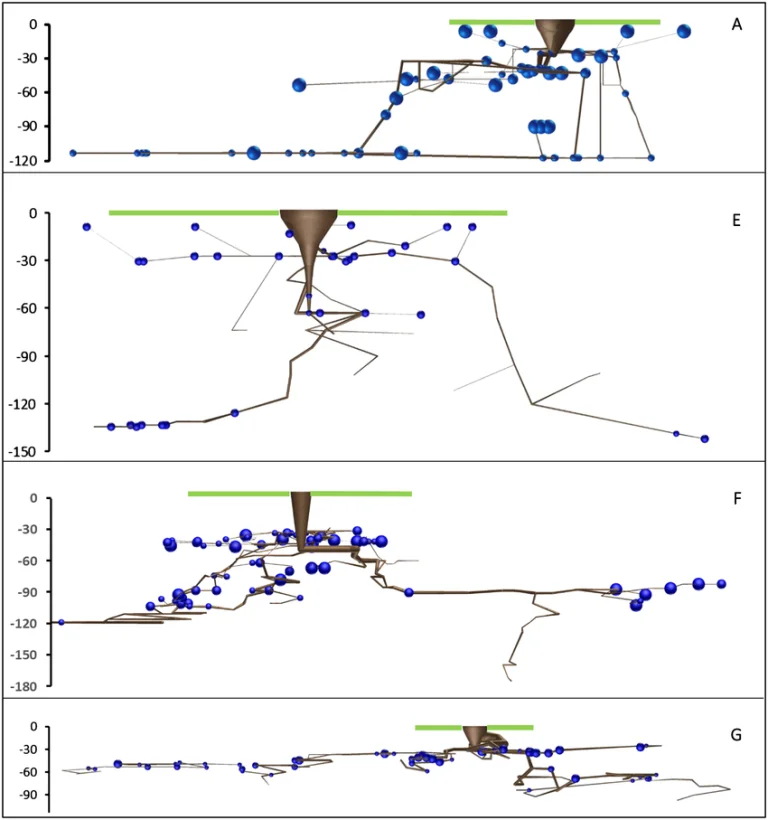
Root system of Welwitschia
This image shows three-dimensional representations of Welwitschia plants viewed from the side, illustrating the mapped paths of the main roots. Starting at the stem (the highest point), with a green bar of 1 metre on either side (horizontal scale). The blue spheres indicate the locations of fine roots, with the size of each sphere corresponding to the relative number of fine roots at that location. The scales on the left show depth intervals of 10 cm below ground.